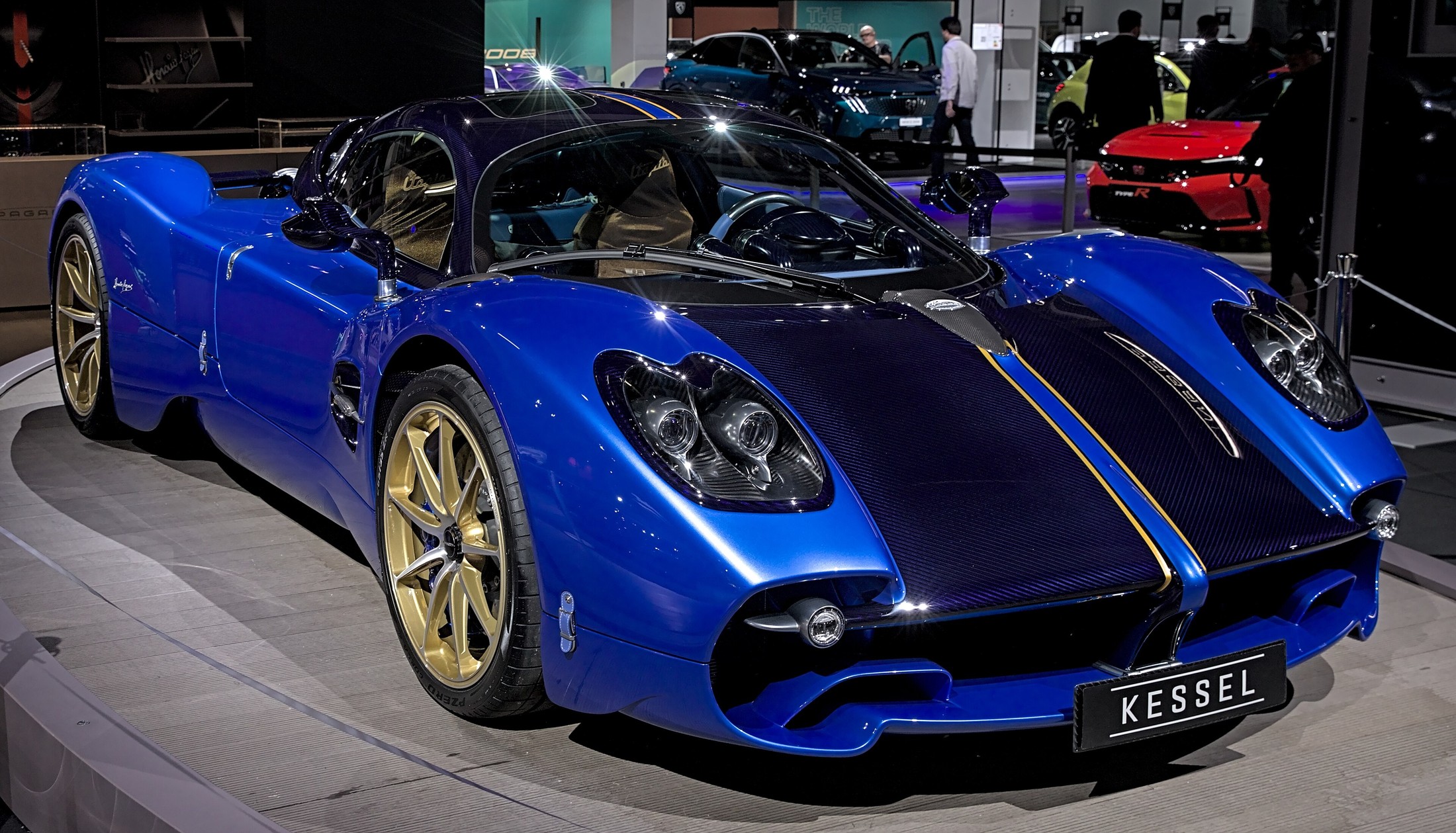
Horacio Pagani arrived in the hypercar market with the Zonda in 1999, followed by the Huayra. The Utopia, the third model, returns to the philosophy of the first: no electric motors, no hybrid system, less weight and more mechanical feel.
The engine is a 6.0-litre twin-turbo V12 built by Mercedes-AMG, producing 864 hp and 1,100 Nm. Buyers choose a seven-speed manual or a seven-speed automated manual from XTRAC, and drive goes to the rear wheels. Pagani quotes 3.1 seconds to 100 km/h and 350 km/h.
The body is built from Carbo-Titanium, a composite of carbon fibre and titanium, over a chromoly steel subframe. Double wishbones with electronically controlled dampers sit at each end, and an active rear wing and front splitter adjust the aerodynamics, which Pagani describes as designed to be invisible.
The interior follows watchmaking: four analogue dials and a small central screen, a steering wheel machined from aluminium billet, metal pedals and buttons. Leather, Alcantara and carbon are specified by each owner, and an interior takes hundreds of hours to trim.
Only 99 cars will be built, starting at around 2.2 million euros. The Utopia is an exception in its market: while rivals stack hybrid systems and electronic control, Pagani increased the density of mechanical connection. Its value lies not in numbers but in how much information a driver receives through hands and feet.
FAKTA KUNCI
- The Utopia is Pagani's third model after the Zonda and Huayra
- A Mercedes-AMG 6.0-litre twin-turbo V12 produces 864 hp and 1,100 Nm
- Seven-speed manual or automated manual, rear-wheel drive, 0-100 km/h in 3.1 seconds
- Production is limited to 99 cars
- The body is built from Carbo-Titanium composite
Bila Anda menilai artikel ini memuat kekeliruan, Anda dapat meminta koreksi atau hak jawab lewat prosedur koreksi kami. Tulis ke press@ateliermbent.com.
BERIKUTNYA · MOTORS KOENIGSEGG GEMERA: 1,700 hp for four people →