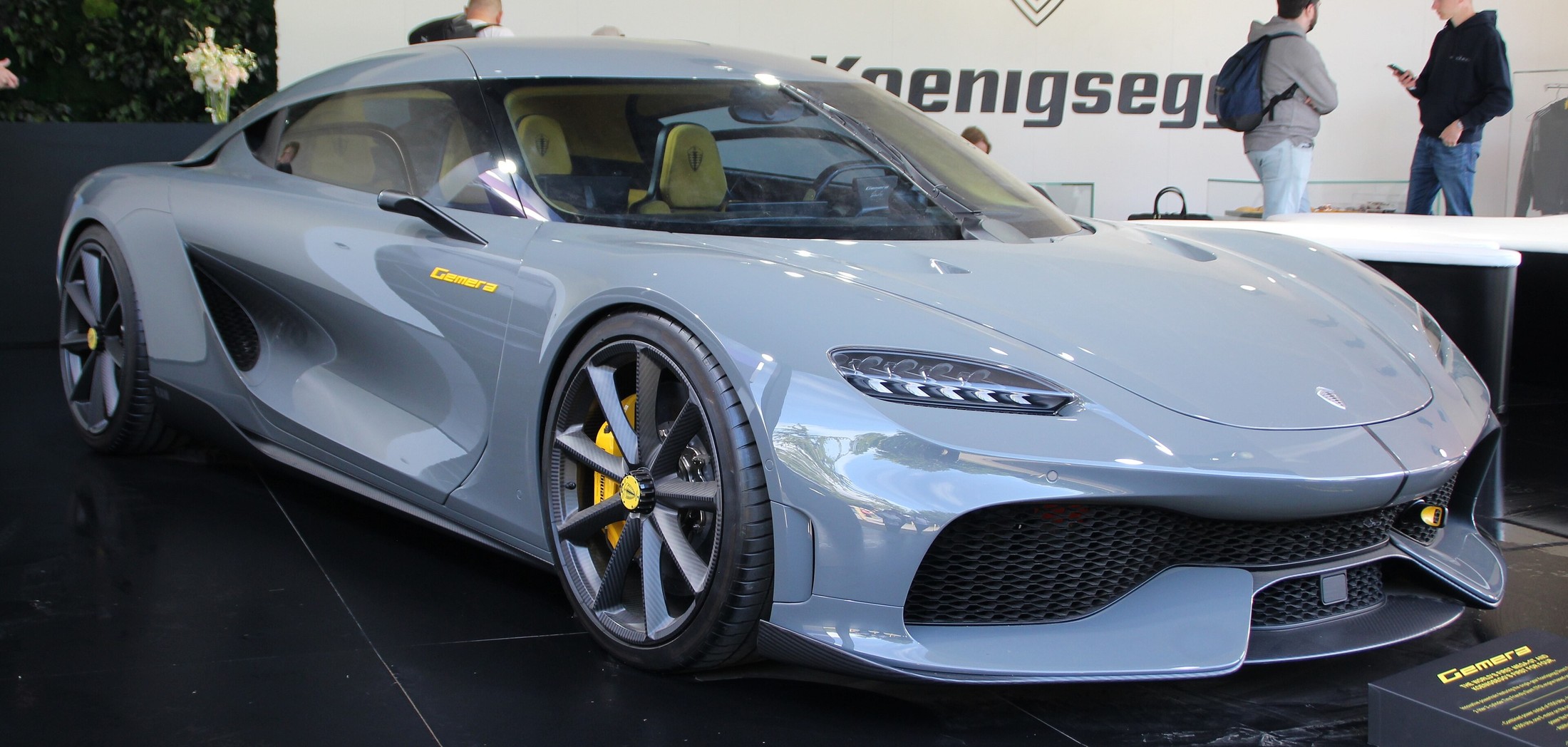
Koenigsegg is a small Swedish manufacturer building a few dozen cars a year, yet each one has reset a speed record. The Gemera is the company's first four-seater. The name means 'to give more' in Swedish, and the car attempts to put hypercar performance and GT space in one body.
The engine is a 2.0-litre three-cylinder Freevalve unit that opens and closes its valves electronically without camshafts, producing 600 hp. One motor on the crankshaft and two on the front axle bring the system to 1,700 hp. Koenigsegg later added a 5.0-litre V8 hybrid version producing 2,300 hp.
The chassis is a carbon monocoque with aluminium honeycomb crash structures. There are four doors, the rear pair opening opposite the front, a carbon roof and cameras in place of a rear window. A front splitter, rear diffuser and speed-sensitive wing manage airflow.
Inside there are four seats: carbon shells in front and a bench behind. A 9-inch display faces the driver and a portrait touchscreen sits in the centre. Eight cupholders, a refrigerator and wireless charging are standard because the people who commissioned the car wanted a hypercar usable every day.
Prices started around 1.7 million euros and the first build slots sold out. The Gemera occupies an odd position: top-tier performance with near-saloon practicality. Koenigsegg built it for a simple reason — some of its customers want a hypercar in which they can take their children to school.
FAKTA KUNCI
- The Gemera is Koenigsegg's first four-seat model
- A 2.0-litre three-cylinder Freevalve engine and three motors produce 1,700 hp
- A later 5.0-litre V8 hybrid version produces 2,300 hp
- Four doors and eight cupholders
- Carbon monocoque with aluminium honeycomb crash structures
Bila Anda menilai artikel ini memuat kekeliruan, Anda dapat meminta koreksi atau hak jawab lewat prosedur koreksi kami. Tulis ke press@ateliermbent.com.
BERIKUTNYA · MOTORS MERCEDES-AMG GT 63: the balance of a second generation →